

Tuvalu Gaming License

Tuvalu Gaming License

A Comprehensive Guide to the Tuvalu Gaming Licensing

Tuvalu Gaming License

The Tuvalu Gaming Authority (TGA) oversees online gaming in Tuvalu, ensuring fair, safe, and transparent operations while providing a credible and efficient regulatory environment for operators worldwide. Governed by the Tuvalu Online Gaming Act, 2023, the TGA maintains high-quality standards through a comprehensive regulatory framework that benefits both players and operators, while keeping pace with the rapid development of the global iGaming industry.

The authority prioritises a clear and responsible regulatory environment, working closely with licensed operators to ensure full compliance across all operational areas. The licensing process, exclusively managed by Tuvalu Gaming Licensing Corp as the authorised representative for application submissions, is characterised by its efficiency and focus on critical areas such as fraud prevention, AML compliance, and the promotion of fair play practices.

This streamlined process underscores the Tuvalu Gaming Authority’s commitment to upholding the highest levels of regulation within the online gaming industry, establishing a clear, accountable, and secure gaming environment for all stakeholders involved.
Tuvalu Gaming License Overview

Tuvalu’s licensing framework is designed to accommodate a wide range of online gaming activities, including casino games, sports betting, poker, lottery, sweepstakes, and more, under a single comprehensive license. This inclusivity enables operators to offer diverse gaming options without the need for multiple licenses across different jurisdictions.

One of the key advantages of obtaining a gaming license in Tuvalu is the streamlined application process, which allows for relatively quick entry into the market compared to other jurisdictions. The cost-effectiveness of the licensing fees, coupled with a 0% gaming tax regime, offers a financially viable solution for startups and established companies looking to maximise their profitability and expand their operational footprint globally.

TUVALU GAMING LICENSE - FREE CONSULTATION

The Tuvalu Gaming License

Corporate and Licensing Framework

  • Corporate Establishment: No local company formation, local presence, or capital investment in Tuvalu is required. Applicants may apply with a company registered in virtually any jurisdiction worldwide, making the framework highly accessible for international operators.
  • License Validity and Structure: Each license is valid for one year and renewable annually. The B2C license covers a broad range of online gaming verticals including casino games, sports betting, poker, lottery, sweepstakes, bingo, and horse racing. The license includes two domains (URLs) as standard, with up to five additional domains available at $500 each.

Licensing Process and Categories

  • The licensing process begins with a fit-and-proper pre-approval assessment for directors, shareholders, and UBOs — conducted free of charge within four working days. This pre-approval-first model ensures operators know they qualify before any application fees are committed.
  • The TGA issues two primary license categories: the Operator License (B2C) for operators offering services directly to players, and the B2B License for platforms, game studios, and technology service providers. Both categories are available at the same cost.

Key Requirements for Application

  • Due Diligence: Standard KYC and KYB documentation is required for all directors, shareholders, and ultimate beneficial owners, including certified passports, recent utility bills, and corporate incorporation documents.
  • Operational Documentation: Applicants must submit a business plan, proof of domain ownership, a platform or software provider agreement, AML/CTF policies, responsible gaming policies, and the signed License Conditions document.
  • Compliance Appointments: A designated Key Person (senior executive) and a Compliance Officer must be appointed and registered with the TGA. A Money Laundering Reporting Officer (MLRO) must also be appointed prior to launch.

Restricted Markets

  • Licensees must adhere to restrictions on operations within specific markets, including Australia, Austria, the United States, France, the United Kingdom, Germany, the Netherlands, Spain, countries subject to international sanctions, FATF Blacklisted countries, and any other jurisdictions designated as prohibited by the Tuvalu Gaming Regulatory Authority. Geo-IP blocking must be implemented to enforce these restrictions.

Advantages of the Tuvalu Gaming License

The Tuvalu Gaming License offers several distinct advantages, making it one of the most attractive options for gaming operators worldwide:

  • Cost-Effectiveness: At $15,850 for both initial issuance and annual renewal, the license is competitively priced with no hidden fees, no mandatory local company formation costs, and no capital reserve requirements at the jurisdictional level.
  • Tax Benefits: Tuvalu imposes a 0% gaming tax on licensed operators, presenting a significant financial advantage by maximising operational profitability from day one.
  • Efficient Processing: The full licensing process typically concludes within 3–4 weeks from application submission to certificate issuance, enabling faster market entry than most comparable jurisdictions.
  • Pre-Approval First: The $1,200 application fee is only payable after pre-approval has been granted — operators are assessed for eligibility before any fees are charged.

Regulatory Safeguards

The Tuvalu Gaming Authority enforces a strict regulatory framework focusing on:

  • Fair Gaming: All games offered by licensees must be independently tested and certified by recognised external testing laboratories, ensuring transparent and unbiased outcomes for players.
  • Player Protection: Robust mechanisms must be in place to safeguard player data, ensure privacy, promote responsible gaming, and prevent access by underage individuals.
  • Financial Reporting: Operators must submit accurate annual financial statements and maintain the financial ratio requirements set by the TGA, ensuring transparency and financial integrity.

Compliance and Auditing

To uphold licensing standards, the Tuvalu Gaming Authority may carry out regular compliance reviews and investigations — both scheduled and unannounced — to verify adherence to all regulatory requirements. Operators are required to undergo periodic internal reviews and independent external audits to confirm ongoing compliance with responsible gaming and operational standards.

The Tuvalu Gaming License offers a comprehensive and well-structured regulatory framework for online gaming operators, emphasising accessibility, fairness, and financial integrity. With straightforward requirements for application, proportionate due diligence, and a transparent pre-approval process, the licensing framework is designed to facilitate a secure and responsible gaming environment. Applicants are encouraged to prepare their submissions carefully, ensuring all documentation meets the TGA’s requirements to leverage the full strategic advantages of operating under a Tuvalu Gaming License.

Licensing Cost Comparison & Taxation

Jurisdiction

Application Timeframe

Local Officer Requirements

License Costs

Annual Renewal Costs

Corporate Taxation

Gaming Tax

Local Server Requirement

Local Company Requirements

Alderney

3-6 months

Yes

£17,500

£35,000-£400,000

0%

0%

No

No

Anjouan

3-4 weeks

No

€17,828

€17,828

0%

0%

Replication

No

Curacao

8-10 weeks

Yes

€54,893

€47,450

2%

0%

Yes

Yes

Cyprus

6-9 months

Yes

€30,000

€30,000

15%

13%

Replication

Yes

Gibraltar

6-9 months

Yes

£100,000

£100,000

12.5%

1% max £425,000

Yes

Yes

Isle of Man

3-6 months

Yes

£36,750 – £52,500

£36,750 – £52,500

0%

0.1 – 1.5%

No

Yes

Kahnawake

4-6 months

No

$40,000

$20,000

0%

0%

Yes

No

Malta

6-12 months

Yes

€25,000 – €85,000

€25,000-€85,000

35%

5% max €600,000

Yes

Yes

Ontario

6-12 Months

No

$100,000

$100,000

15%

15-25%

No

No

Tobique

6-8 weeks

No

€36,000

€18,000

0%

0%

Compliance Platform

No

Tuvalu

3-4 weeks

No

$15,850

$15,850

0%

0%

No

No

United Kingdom

3-6 months

No

£4,224- £91,686

£4,199-£793,729+

19%-25%

15%-21%

No

No


  • The figures presented in the table above serve as estimates and are provided for informational purposes. It’s important to note that certain costs are approximations and may vary based on fluctuations in exchange rates.
  • It’s crucial to understand that the mentioned costs exclusively pertain to licensing fees and do not encompass expenses associated with legal fees, compliance procedures, or liaising with gaming regulatory authorities.
  • Furthermore, it’s essential to consider that additional charges might apply, including fees for key person licenses, local substance requirements, minimum capital obligations, and other regulatory prerequisites beyond the scope of the license costs.

Explore the diverse jurisdictions we specialise in through our comprehensive licensing support. Select a location from the dropdown menu to gain detailed insights into each region’s licensing landscape, requirements, and strategic advantages for your iGaming venture.

The Tuvalu Gaming License FAQ

What is the cost of obtaining a Tuvalu Gaming License?

The total cost is $15,850, which covers the issuance of the license including the official digital certificate, the TGA seal for website display, and listing on the public register of licensed operators. The same amount applies for annual renewal. A one-time application fee of $1,200 is payable upon submission of the full application — but only after pre-approval has been granted by the TGA.

How long does the process to obtain a Tuvalu Gaming License take?

The full process — from initial pre-approval submission to receiving the official license certificate — typically takes 3 to 4 weeks. The pre-approval stage alone takes up to four working days.

What is the pre-approval process and is it free?

Yes, the pre-approval stage is entirely free of charge. Applicants submit their KYC and KYB documentation and the TGA conducts a fit-and-proper assessment. The $1,200 application fee is only payable once pre-approval has been confirmed, meaning operators know they qualify before committing any application funds.

For how long is the Tuvalu Gaming License valid?

The license is valid for one (1) year and is renewable annually at the same cost of $15,850.

How many domains are included in the license?

Each B2C license includes two domains (URLs) as standard. Up to five additional domains can be added at $500 per domain.

Is a local company or physical presence in Tuvalu required?

No. There is no requirement to establish a local company, maintain a physical office, or appoint a local representative in Tuvalu. Companies registered in any jurisdiction worldwide may apply directly.

What is the gaming tax rate under a Tuvalu Gaming License?

Tuvalu imposes 0% gaming tax on licensed operators. Revenues generated by licensed operations are not subject to gaming-specific taxation at the jurisdictional level.

What types of gaming activities are permitted under the license?

Licensees may offer a broad range of online gaming activities, including casino games (slots, table games, live dealer, RNG-based content), sports betting, e-sports, poker, lottery, sweepstakes, bingo, and horse racing. The license covers both B2C (operator-to-player) and B2B (technology and platform provider) models.

What KYC and KYB documents are required for the application?

For each director, shareholder, and ultimate beneficial owner, applicants must provide a certified passport (certified by a lawyer, not older than 3 months), a recent utility bill confirming the current address (not older than 3 months, in English or translated and certified), and for entities, a full incorporation set in English or translated with certification by a lawyer.

What operational documents must be submitted with the application?

The full application package must include a completed B2C or B2B Application Form, a business plan describing the intended gaming operations, proof of domain ownership, a platform or software provider agreement, AML/CTF policies, responsible gaming policies, and the signed License Conditions document.

What key personnel must be appointed?

Licensees are required to designate a Key Person (a senior executive responsible for the business) and a Compliance Officer responsible for reporting on gaming compliance matters to the TGA on a regular basis. A Money Laundering Reporting Officer (MLRO) must also be appointed to report suspicious transactions to the appropriate authorities.

What territories are restricted under the Tuvalu Gaming License?

Licensees are prohibited from promoting their services to, or registering players from, any restricted jurisdictions. These include (but are not limited to) Australia, Austria, the United States, France, the United Kingdom, Germany, the Netherlands, Spain, countries under international sanctions, FATF Blacklisted countries, and any other jurisdictions designated by the Tuvalu Gaming Regulatory Authority. Geo-IP blocking must be implemented to enforce these restrictions.

What are the identity verification requirements for players?

Before processing any payout, licensees must verify the player’s identity by collecting a valid government-issued photo ID and a recent utility bill in the player’s name. The same identity verification must be conducted whenever a player’s total cumulative deposits exceed USD $10,000 or its equivalent in any currency.

What AML policies and obligations must licensees follow?

Licensees must take all necessary precautions to prevent their services from being used for money laundering purposes. This includes maintaining a risk-based AML/CTF programme, player identification procedures, record-keeping, suspicious transaction detection, internal reporting of suspicious activities, player payment protocols, and regular staff training. An MLRO must be appointed to report suspicious transactions to relevant authorities.

Are there Responsible Gaming obligations?

Yes. Licensees must implement tools and controls that help users manage their gaming activity, including options for voluntary self-exclusion, time tracking and session reminders, and daily, weekly, or monthly caps on spending and deposits. Effective age verification systems must be in place to ensure only individuals aged 18 or older can participate. Players must have 24/7 access to confidential assistance and helplines.

What are the requirements for player complaint procedures?

Licensees must provide a clear and accessible mechanism for players to lodge complaints. Player complaints must be acknowledged within 1 business day and resolved within a reasonable timeframe, typically 14 days. All operators are required to participate in an Alternate Dispute Resolution (ADR) process with a TGA-approved ADR provider, at their own expense, for any disputes that cannot be resolved informally. Players must be informed of their right to escalate unresolved complaints to the Tuvalu Gaming Authority.

Is there a requirement to segregate player funds?

Yes. Player balances must be kept in protected, segregated accounts and made available for withdrawal in a timely and efficient manner. Player funds must be held separately from operational funds.

What are the TGA seal and website display requirements?

The official Tuvalu Gaming Authority seal must be prominently displayed across the entire website, including in the footer, using only the official unmodified code provided by the Authority. The website must also clearly display the license number, the full legal name of the company, registration number, and legal address in the footer, along with visible links to all essential policies, terms, and contact information.

What website technical and security standards apply?

Operators must use SSL encryption (HTTPS) to ensure secure transmission of player data. Strong cybersecurity infrastructure including firewalls and intrusion detection systems is required. Operators must enforce strong password requirements and offer two-factor authentication (2FA). Website uptime of 99.9% is required, with contingency and backup systems in place. All games must be independently tested and certified by approved third-party testing laboratories such as iTech Labs, BMM, or GLI.

What actions require notification to the TGA?

Licensees must notify the TGA: within 10 business days of any change in beneficial ownership of 5% or more; within 3 business days of any significant incident that could negatively impact operations or Tuvalu’s reputation as a gaming jurisdiction; immediately upon suspension, termination, or revocation of any gaming license held in any other jurisdiction worldwide; and promptly upon any material changes to information submitted during the licensing process.

Are there financial reporting requirements?

Yes. Licensees must submit accurate annual financial statements and consistently meet the financial ratio requirements set by the Tuvalu Gaming Regulatory Authority, which are communicated periodically in writing. Operators are required to undergo periodic internal reviews and independent external audits to confirm compliance with responsible gaming and financial standards.

Are there marketing restrictions?

Yes. Advertising materials must reflect reality and must not exaggerate the odds of winning or downplay the risks associated with gambling. All promotional content must include visible responsible gaming messages and must exclude individuals under the age of 18. Marketing must not target individuals identified as at-risk or exhibiting problematic gaming behaviour. Bonus terms and conditions must be presented in a clear and accessible manner.

What are the GDPR and data protection requirements?

Licensees must comply with data protection laws applicable to each territory they target. Personal and financial information collected from players must be managed lawfully, securely, and with the user’s informed consent. A Privacy Policy must be accessible from the website footer at all times. Sensitive player data must be stored in encrypted databases, and systems must be regularly tested for vulnerabilities.

Are there any approved Payment Service Providers for Tuvalu-licensed operators?

Yes. The following PSPs have officially approved and confirmed support for operators holding a Tuvalu Gaming License: <strong>INQUD, ONSTAR, FINERA, S-INTERIO,</strong> and <strong>CHAMPAY</strong>. Additionally, the following leading PSPs are currently in advanced integration stages: <strong>Truevo, Paydo, PayRetailers, Fibonatix, PayKings, PayPro, MiFinity, Starpago,</strong> and <strong>D24</strong>. An additional 8–10 providers are expected to finalise approvals by mid-2026.

What gaming content and platform providers support the Tuvalu license?

The following gaming content and platform providers have confirmed support for operators licensed under the Tuvalu framework: <strong>Betsoft, MegaFair Technologies, IGP Gaming, GAMMASTACK, GR8 Tech, LaCasa Software, Spadegaming,</strong> and <strong>Turbo Games</strong>. Additional provider approvals are expected by mid-2026.

Is an onsite audit required?

No onsite audit is required. Compliance reviews and investigations may be conducted by the TGA both on a scheduled and unannounced basis, and independent third-party audits are required periodically.

Corporate Structure

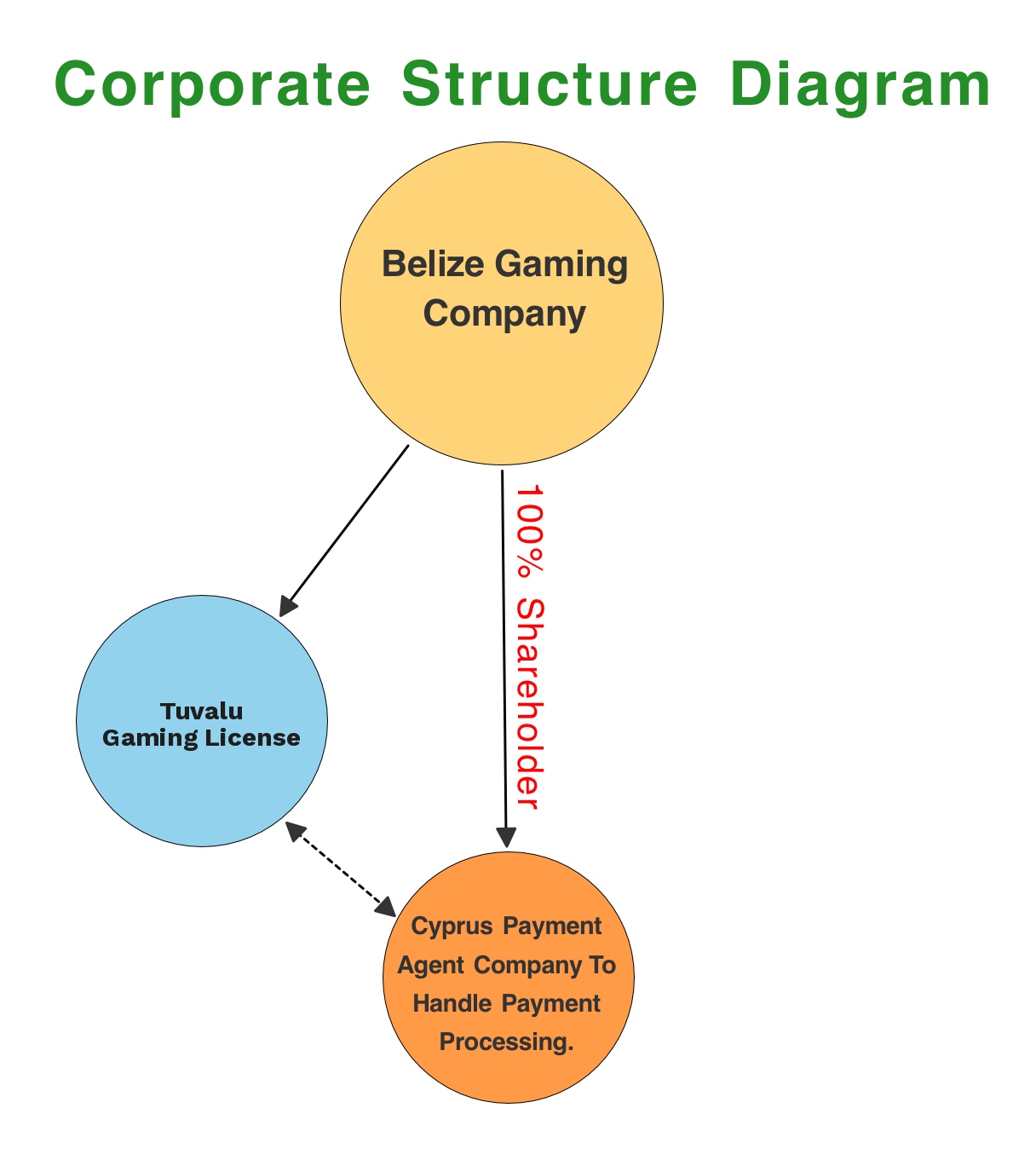
This innovative corporate structure leverages jurisdictional advantages across Belize and the EU, optimising financial operations and regulatory compliance.

A strategic corporate structure leveraging the Tuvalu Gaming License alongside a complementary payment and operational entity can optimise financial operations and regulatory compliance for iGaming operators.

A commonly utilised structure involves a holding or operating company incorporated in a favourable offshore jurisdiction — such as Belize, the BVI, or a similar IBC jurisdiction — holding the Tuvalu Gaming License and operating the gaming platform. This parent entity benefits directly from Tuvalu’s 0% gaming tax environment and the global market access provided by the TGA’s regulatory framework.

A wholly-owned subsidiary — for example, a Cyprus Payment Agent Company — can be established to handle payment processing and financial operations. Cyprus’s EU membership, favourable corporate tax rate, and robust banking infrastructure make it an ideal jurisdiction for managing player fund flows, payment processing relationships, and financial reporting obligations. This configuration enables efficient financial transactions and bolsters the operator’s credibility with payment service providers and financial institutions.

This dual-entity structure also distributes regulatory and operational risks across jurisdictions, providing flexibility to respond to regulatory developments, optimise tax liabilities, and tailor services to diverse market requirements. Our advisory team can provide detailed guidance on the most appropriate corporate structure for your specific operational needs and target markets.

TUVALU GAMING LICENSE – FREE CONSULTATION

Corporate structure for tuvalu gaming license

Benefits of a Tuvalu Gaming License

Explore the strategic benefits of the Tuvalu Gaming License, providing both emerging startups and established gaming enterprises with a range of advantages tailored to ease market entry, increase operational agility, and enhance profitability under a clear and supportive regulatory environment.

For Start-ups

  • Cost-Effectiveness: At $15,850 for issuance and annual renewal, the Tuvalu Gaming License is one of the most competitively priced iGaming licenses available. The application fee of $1,200 is only payable after pre-approval, meaning new ventures can confirm their eligibility before committing funds — an exceptionally operator-friendly approach for startups managing tight budgets.
  • Streamlined Application Process: The Tuvalu license offers a straightforward and efficient application process, allowing new companies to receive their license within 3–4 weeks, minimising downtime and accelerating market entry compared to most alternative jurisdictions.
  • No Local Presence Required: Startups can apply from anywhere in the world without the requirement to incorporate locally, maintain a physical office in Tuvalu, or appoint a local representative — removing significant administrative and financial barriers to entry.
  • Tax Advantages: With 0% gaming tax on gross gaming revenue, new gaming companies can maximise profitability from day one, reinvesting revenue into product development and player acquisition rather than regulatory tax obligations.
  • Flexibility in Gaming Options: Tuvalu’s licensing framework covers a broad range of online gaming services — including casino, sports betting, poker, lottery, and more — enabling new companies to explore multiple market segments under a single license.
  • Growing Payment Ecosystem: With multiple PSPs already officially supporting the Tuvalu license and a strong pipeline of additional integrations underway, startups can launch with confidence in their ability to process player payments from day one.

For Existing Gaming Companies

  • Expansion Opportunities: Established gaming companies can leverage the Tuvalu license to enter new markets and diversify their operational and product offerings, benefiting from the TGA’s growing recognition within the global iGaming industry.
  • Regulatory Compliance: Existing operators can strengthen their regulatory compliance portfolio by adding a Tuvalu license, demonstrating adherence to a comprehensive and enforceable regulatory framework and reinforcing their commitment to responsible gaming.
  • Cost Management: For companies looking to optimise operational costs, the Tuvalu license presents a highly cost-effective solution. At $15,850 per year with 0% gaming tax, it offers substantially lower ongoing costs than most Tier 1 and many Tier 2 jurisdictions.
  • Increased Player Trust: Operating under a credible, regulated jurisdiction backed by enforceable licensing conditions, player protection requirements, and mandatory ADR processes enhances player confidence and supports long-term brand credibility.
  • PSP and Platform Compatibility: The rapidly expanding list of approved PSPs and gaming content providers supporting the Tuvalu license means established operators can integrate Tuvalu-licensed operations into existing infrastructure with minimal friction.
  • Operational Flexibility: The Tuvalu license allows for operational scalability, enabling existing gaming companies to introduce new gaming verticals, expand their domain portfolio, and grow their player base without the delays and costs associated with re-licensing in more restrictive jurisdictions.

TUVALU GAMING LICENSE - FREE CONSULTATION
Plex Gaming - Serving the iGaming World since 1999
Privacy Overview

This website uses cookies so that we can provide you with the best user experience possible. Cookie information is stored in your browser and performs functions such as recognising you when you return to our website and helping our team to understand which sections of the website you find most interesting and useful.